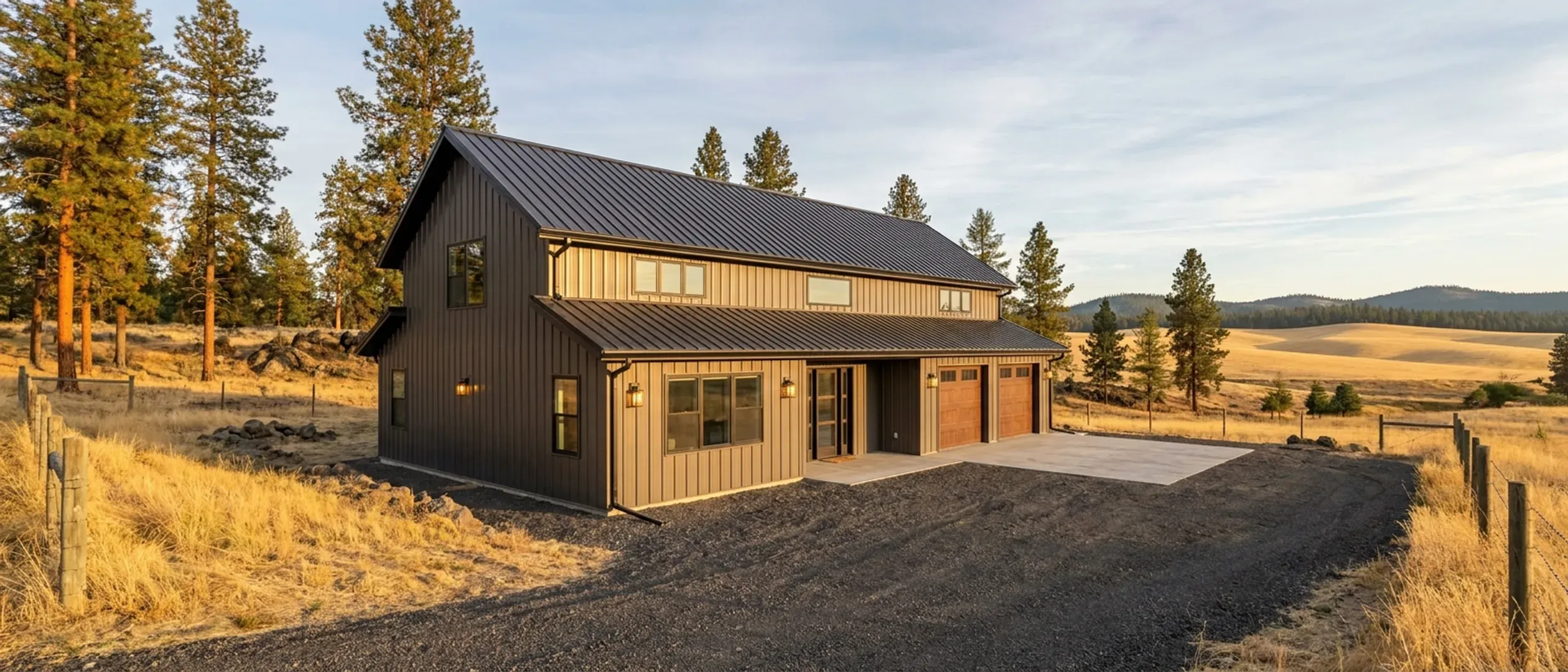
Are Barndominiums Legal in Washington State?
Yes, barndominiums are legal in Washington. No state law singles them out. A barndominium with living space is a house, and the State Building Code Act puts one building code in effect in every city and county. Cities and counties enforce it and issue the residential building permit. The building is rarely the obstacle. The land is. Before any permit, Washington requires evidence of an adequate water supply, and in several watersheds a new home on a new household well comes with a fee and a lower withdrawal limit recorded on the title. County zoning, set under the Growth Management Act, decides how many homes the land can hold. The septic system needs its own permit from the local health jurisdiction. This page sets out each layer in the order it matters, cites the statute or rule behind every point, and ends with the questions to ask before you buy land or apply. It is general information, not legal advice for a specific parcel.
Figures on this page are cited third-party or government data, not a quote from Washington Barndominium Builders.
Bottom Line Up Front
- A barndominium is legal in Washington as a house. It is built to the 2021 International Residential Code as amended by the state and the 2021 Washington State Energy Code, with the permit issued by the city or county.
- Water is the first gate. A building permit for a home needs evidence of an adequate water supply: a purveyor's letter, a water right, or in most areas a water well report. Some watersheds add a $500 fee and a lower limit for new household wells.
- County zoning sets the real lot size, septic needs a permit from the local health jurisdiction, and there is no statewide wildfire building code in force, although some local governments adopt their own.
Can You Build a Barndominium in Washington State?
Yes, where the land allows a house. The same building can be straightforward on one parcel and impossible on the next, and the zone and the water decide.
Inside a city
City zoning applies, and a barndominium is permitted like any other house where the zone allows one. Lots are usually small and acreage is rare. Ask the city planning department whether the zone's height, setback and design rules fit a large metal or pole barn building.
Rural zones in the county
Land in a county's rural element is planned for rural homes at the densities the county sets. This is usually the simplest land for a barndominium, subject to the county's minimum lot size, setbacks and the water and septic answers.
Farm, forest and other resource land
Counties designate agricultural, forest and mineral resource lands separately from the rural element, and their rules for homes on those lands differ. Ask the county planning department before assuming a home is allowed.
Near a shoreline
RCW 90.58.030 defines shorelands as land within 200 feet of the ordinary high water mark, plus associated floodways, floodplains and wetlands. An owner's own single-family home no taller than 35 feet is exempt from a shoreline substantial development permit, but it must still meet the local shoreline master program.
An existing barn or shop
An existing barn or shop cannot simply be lived in. State law says an agricultural structure may not be a place of human habitation, so converting one means a residential building permit, water evidence and a septic permit like any new home.
Water, wells and septic
On rural land these three decide more than the building does.
The evidence a permit needs
A purveyor's letter, a water right permit, or in many areas a water well report. The well is usually drilled before the building permit is issued, and a well contractor, not the builder, does that work.
The 5,000 gallon household exemption
A household well of up to 5,000 gallons a day for domestic use needs no water right permit under RCW 90.44.050. That exemption does not by itself guarantee a building permit: the permit still needs evidence of an adequate supply, and some watersheds set lower limits.
Streamflow Restoration watersheds
RCW 90.94 lists the watersheds where a new home on a new permit-exempt well pays a $500 fee and accepts an annual-average limit of 950 or 3,000 gallons a day, recorded on the title. The county building department can tell you whether a parcel is in one.
Septic: the local health jurisdiction
The permit comes from the county's local health jurisdiction after a soil and site evaluation and a design that keeps room for a replacement drainfield. Puget Sound counties also run management programs with operation and maintenance requirements.
The dig notice
RCW 19.122.030 requires notice through the one-number locator service at least two full business days, and not more than 10, before excavation. The well, septic, water line and footings all dig.
Code details that affect a barndominium
A barndominium follows the same code as any house, but a few parts of it weigh more heavily on a metal or pole barn building.
Snow, wind, seismic and frost values are set locally
WAC 51-51-0301 leaves the climatic and geographic design criteria in Table R301.2 to the local jurisdiction. There is no statewide snow load or frost depth. Ask the building department for its figures before ordering a kit, and have the supplier's engineering meet them.
Energy code credits
WAC 51-11R-40620 requires every new home to earn additional energy efficiency credits: 5.0 for a small dwelling under 1,500 square feet with less than 300 square feet of windows, 9.0 for a dwelling over 5,000 square feet, and 8.0 for the rest. That is on top of insulation minimums such as R-60 ceilings and R-20+5 or R-13+10 wood-frame walls in WAC 51-11R-40213. The permit drawings must show which credit options were chosen, which shapes how a steel or pole barn shell is insulated and heated.
No statewide wildfire building code in force
The Building Code Council's wildland-urban interface rules are reserved until the Department of Natural Resources completes statewide wildfire mapping. Under RCW 19.27.560, counties, cities and towns may adopt the International Wildland Urban Interface Code themselves, so check whether yours has.
Modular, manufactured and kit homes
Under RCW 43.22.455, factory-built housing needs the Department of Labor and Industries' insignia of approval before it is installed, while zoning, setbacks and site rules stay local under RCW 43.22.460. Manufactured homes follow the federal HUD standards. A kit shipped as frame, steel and panels is assembled on site under a local building permit. State law also defines a narrow 'kit home' category of 800 square feet or less and has directed the Building Code Council to write rules for it by March 31, 2027. Larger barndominium kits are permitted like any other new house.
Plans, builders and owner-builders
Who can draw the plans and who can do the work are both set in state law.
No architect required for a house
RCW 18.08.410 lets any person do the design work for a residential building of up to four dwelling units, or a farm building and its garage, barn or shed. Your building department may still require engineered drawings for a steel or pole barn structure.
The titles themselves are protected
RCW 18.08.310 and RCW 18.43.010 make it unlawful to use the title architect or professional engineer, or to imply it, without being registered in Washington. When a design needs a stamp, it comes from a Washington-licensed professional.
Contractors must register with the state
RCW 18.27.020 requires every contractor to register with the Department of Labor and Industries, and it is a gross misdemeanor to offer or perform work as a contractor without registering. Anyone hiring a builder can check a contractor's registration with the department.
Owner-builders
RCW 18.27.090 exempts a person working on his or her own property from contractor registration, and an owner who contracts the project with a registered contractor. The building permit, inspections, water evidence and septic permit apply to an owner-built home exactly as to any other.
Taxes to plan for
Two tax rules catch people building on land they already own.
Sales tax on custom construction
RCW 82.04.050 treats building a structure for a consumer as a retail sale, and the Department of Revenue says prime contractors must collect retail sales tax from the landowner on the gross contract price. Budget for it on the whole build, at the rate for the job site.
Land enrolled in current use
If the acreage is classified as open space, farm and agricultural, or timber land under chapter 84.34 RCW, RCW 84.34.080 says a change to another use brings additional tax and a 20 percent penalty. Talk to the county assessor before building on enrolled land.
What to ask before you buy or apply
These questions answer most of what decides whether a barndominium works on a particular parcel.
What is the zone, and what is the minimum lot size?
Ask the county or city planning department for the zoning, the density it allows, and the setbacks and height limits, in writing where possible.
Where will the water come from, and is the parcel in a restricted watershed?
Ask the building department what water evidence it needs for that parcel, whether a purveyor serves it, and whether a Streamflow Restoration fee and limit or an instream-flow rule applies.
Will the soil take a septic system?
Ask the local health jurisdiction what the soil and site evaluation requires, and leave room on the site plan for a reserve drainfield.
Which building department serves the address, and what are its design values?
Get its snow load, wind, seismic and frost figures before ordering a kit, and ask whether it has adopted a wildland-urban interface code.
Is the land within 200 feet of a shoreline, or enrolled in current use?
Either adds a step: the local shoreline master program, or a conversation with the county assessor about back taxes.
Reading this because you are weighing a build? The next step is a plan drawn for your program.
What's different in Washington State
One statewide code for every house
RCW 19.27.031 puts the state building code in effect in all counties and cities, including the International Residential Code. Under WAC 51-51-003 the edition in force is the 2021 International Residential Code, adopted with Washington's own additions and amendments, effective March 15, 2024. Energy provisions are in the 2021 Washington State Energy Code, Residential, chapter 51-11R WAC. The State Building Code Council has scheduled the 2024 editions to take effect May 3, 2027, with final adoption still pending in September 2026. A barndominium is designed and inspected to the same code as any other house.
Cities and counties issue the permit
RCW 19.27.050 says the state building code is enforced by the counties and cities, and that a county or city without its own building department must contract with another jurisdiction or an approved inspection agency. RCW 19.27.015 defines a residential building permit as one issued by a city or a county. Local amendments to the code for single-family homes need the State Building Code Council's approval under RCW 19.27.074. In practice, ask the city if the land is inside city limits and the county if it is not, and confirm on the jurisdiction's own site.
A home is not an agricultural structure
RCW 19.27.015 defines an agricultural structure as one designed and constructed to house farm implements, hay, grain, poultry, livestock or other horticultural products, and says it may not be a place of human habitation. Whatever treatment a farm building gets locally, a barndominium with living space is a house and needs a residential building permit. A shop or barn with no living space is a different question for the local building department.
Water comes before the permit
RCW 19.27.097 requires every applicant for a building permit for a building that needs potable water to provide evidence of an adequate water supply for its intended use. The evidence can be a water right permit from the Department of Ecology, a letter from an approved water purveyor, or another form that verifies the supply, and in many areas a water well report. An application for a water right is not enough. The city or county may require connection to a public water system that is willing and able to serve. A building that needs no potable water, such as a shop, is exempt from this requirement.
Household wells and the Streamflow Restoration Act
RCW 90.44.050 lets a household well supply single or group domestic use of up to 5,000 gallons a day without a water right permit. The Department of Ecology says the Streamflow Restoration Act responded to the Hirst decision, a 2016 Washington Supreme Court decision that limited a landowner's ability to get a building permit for a new home relying on a permit-exempt well. Under RCW 90.94, in listed watersheds a new home on a new permit-exempt well pays a $500 fee, is limited to an annual average of 950 or 3,000 gallons a day depending on the watershed, and has the restriction recorded on the property title. The Nooksack watershed is governed by its own Ecology rule, and other watersheds have instream-flow rules that set their own requirements. A permit-exempt well built before January 19, 2018 is deemed evidence of an adequate supply.
County zoning under the Growth Management Act
RCW 36.70A.070 requires each county's comprehensive plan to include a rural element that permits rural development, forestry and agriculture and provides for a variety of rural densities. The county's zoning code then sets the actual minimum lot size and what can be built on a parcel. There is no single statewide rural lot size. The county or city planning department is the place to confirm what a specific parcel allows.
Septic needs its own permit
WAC 246-272A-0200 says anyone proposing to install an on-site sewage system must apply for and obtain a permit from the local health officer before construction begins. The application includes a soil and site evaluation, a site plan showing a reserve area for a replacement drainfield, the source of drinking water, and the designer's stamp. Under WAC 246-272A-0015, the health officer in each Puget Sound county keeps a written local management plan that covers operation, maintenance and monitoring requirements.
Pros and cons, honestly
Pros
- One statewide building code applies in every city and county.
- A barndominium is permitted as a house, with no special category to fit.
- Anyone may design a single-family home without an architect, although a building department may require engineered drawings.
- Household wells up to 5,000 gallons a day need no water right permit.
Cons
- A building permit needs evidence of an adequate water supply first.
- Some watersheds add a $500 fee and a lower, recorded limit on new household wells.
- Energy code credits and insulation minimums are a significant cost in a metal or pole barn shell.
- Snow, seismic, wind and frost values, and any wildfire code, vary by jurisdiction.
- Retail sales tax applies to the full contract price of building on your own land.
Are barndominiums legal in Washington?
Can you build a barndominium in Washington State?
What building code applies to a barndominium in Washington?
Who issues building permits in Washington?
Do I need water before I can get a building permit?
Can I drill a well for my barndominium without a water right?
Is a barndominium exempt as an agricultural building?
Do I need a septic permit?
Does Washington have a wildfire building code?
Do I need an architect to design a barndominium in Washington?
Can I build my own barndominium in Washington?
Questions answered? Tell us what you want to build and we will put real numbers against it.
Sources
- Revised Code of Washington — RCW 19.27.031 (state building code in effect in all counties and cities)
- Revised Code of Washington — RCW 19.27.015 (definitions: agricultural structure, residential building permit)
- Revised Code of Washington — RCW 19.27.050 (enforcement by counties and cities)
- Revised Code of Washington — RCW 19.27.074 (State Building Code Council duties)
- Washington Administrative Code — WAC 51-51-003 (International Residential Code adopted)
- Washington Administrative Code — WAC 51-51-0301 (design criteria, Table R301.2)
- Washington Administrative Code — WAC 51-11R-40620 (additional energy efficiency credits)
- Washington Administrative Code — WAC 51-11R-40213 (insulation and fenestration requirements, Table R402.1.3)
- Washington State Building Code Council
- Revised Code of Washington — RCW 19.27.560 (International Wildland Urban Interface Code)
- Revised Code of Washington — RCW 19.27.097 (evidence of adequate water supply)
- Revised Code of Washington — RCW 90.44.050 (permit-exempt groundwater withdrawals)
- Revised Code of Washington — Chapter 90.94 RCW (streamflow restoration)
- Washington Department of Ecology — Streamflow restoration
- Washington Department of Ecology — Groundwater permit exemption
- Revised Code of Washington — RCW 36.70A.070 (comprehensive plans, rural element)
- Revised Code of Washington — RCW 90.58.030 (shorelands; single-family residence exemption)
- Washington Administrative Code — WAC 246-272A-0200 (on-site sewage permits)
- Washington Administrative Code — WAC 246-272A-0015 (Puget Sound local management plans)
- Washington State Department of Health — Local health jurisdictions
- Revised Code of Washington — RCW 19.122.030 (notice before excavation)
- Revised Code of Washington — RCW 43.22.455 and 43.22.460 (factory built housing)
- Revised Code of Washington — RCW 19.27.620 (kit homes rule-making)
- Revised Code of Washington — RCW 18.08.410 (architects: application of chapter)
- Revised Code of Washington — RCW 18.08.310 (architect title)
- Revised Code of Washington — RCW 18.43.010 (professional engineer title)
- Revised Code of Washington — RCW 18.27.020 (contractor registration required)
- Revised Code of Washington — RCW 18.27.090 (exemptions)
- Washington Department of Labor and Industries — Register as a contractor
- Revised Code of Washington — RCW 82.04.050 (retail sale includes construction for consumers)
- Washington Department of Revenue — Custom construction
- Revised Code of Washington — RCW 84.34.080 (current use: change in use)
Keep reading
The pages that answer the next question this one raises.
How long does a barndominium take to build?
Water, septic and the permit, in the order they happen.
Read itBarndominium pros and cons in Washington
Rain, condensation, earthquakes, snow and appraisal.
Read itAre barndominiums worth it in Washington?
When the rules and the land make one worth building.
Read itPermitting
How the permit process works in practice.
Read itSite preparation
Clearing, grading and getting the site ready.
Read itStart the survey
Tell us about your land and what you want to build.
Read itWant a real number instead of a range?
Start the survey and tell us about your land and what you want to build. Include the county and the parcel number if you have them, because in Washington the county zoning, the septic permit from the local health jurisdiction and the water answer change the budget more than the building does. The survey costs nothing.