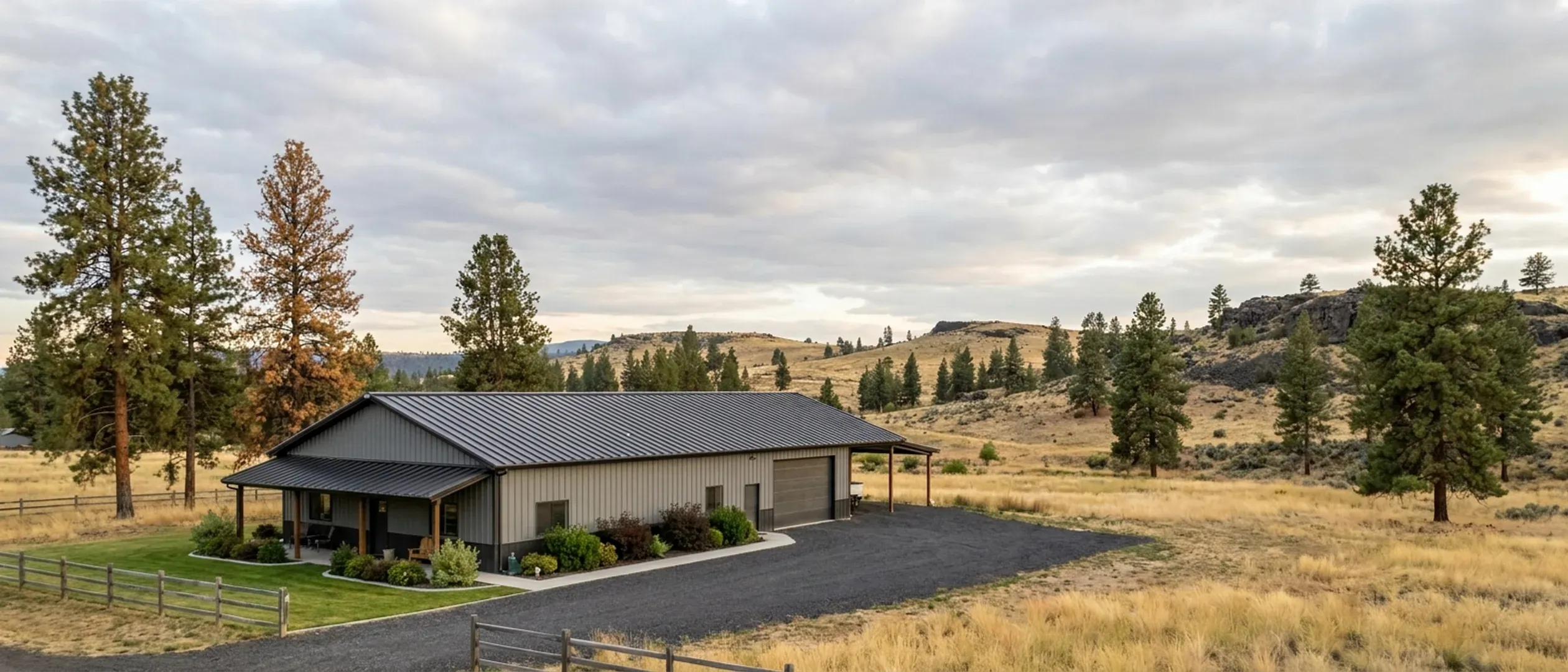
Barndominium Financing in Washington State
There is no such thing as a barndominium loan. A lender finances a house, and a barndominium with living space is a house, so the question is which kind of house loan fits a home that has not been built yet on rural land that may have no comparable sales nearby. Most of the answer is a construction-to-permanent loan from a lender that does rural construction, and the published rules show what those loans require: an approved builder, an appraisal of the finished house, and a construction period with a deadline. This guide sets out those rules from Fannie Mae, HUD, USDA and the VA statute, what the Washington State Housing Finance Commission's programs cover, and the Washington items that belong in the loan budget, such as the sales tax on your construction contract. We do not arrange or broker loans; everything here comes from the lenders' and agencies' own published rules.
Figures on this page are cited third-party or government data, not a quote from Washington Barndominium Builders.
Bottom Line Up Front
- Most new custom homes are financed conventionally or paid in cash. In the Census Bureau's 2025 figures for houses built by a contractor on the owner's land in the West, 65% were financed with a conventional loan and 32% paid in cash; FHA and VA together financed about 3%.
- A single-closing construction-to-permanent loan is the usual route. Under Fannie Mae's rules the construction period can run no more than 12 months at a time and 18 months in total, and a lot you already own counts toward the loan-to-value on the appraised as-completed value.
- Washington adds lines a lender will want in the budget: retail sales tax on the full construction contract, proof of an adequate water supply before the building permit, and a septic permit from the local health jurisdiction.
What actually moves the number
The lender, not the loan type
Whether a barndominium is financeable depends mostly on whether the lender does rural construction lending. Farm Credit lists AgWest Farm Credit as a Farm Credit institution serving Washington, and AgWest's home loan page lists shop-homes and barndominiums among the properties it finances. Local banks and credit unions that keep construction loans in-house are the other usual source.
An approved builder
Construction lenders approve the builder as well as the borrower. HUD's handbook requires the builder on an FHA construction-to-permanent loan to be a licensed general contractor, and AgWest's construction FAQ says it has an approval process for general contractors and does not permit do-it-yourself construction.
The appraisal
The loan is sized on what the finished house appraises for. AgWest's FAQ notes that the cost to build does not always equal the appraised value; where they differ, the borrower brings the gap in cash or changes the plan.
The rate
Freddie Mac's weekly survey put the average 30-year fixed mortgage rate at 7.03% and the 15-year at 6.42% for the week of September 24, 2026, against 6.30% for the 30-year a year earlier. Construction loans are priced by each lender, often with interest-only payments while the house is built.
Barndominium Loans: What Actually Exists
Lenders finance houses. A barndominium qualifies when it is a finished, permitted dwelling that appraises as one.
How new custom homes are paid for
The Census Bureau's 2025 data on houses built by a contractor on the owner's land in the West shows 65% financed with conventional loans, 32% paid in cash, and about 1% each through FHA and 2% through VA. Nationally the split was 70% conventional and 27% cash. A barndominium buyer is most likely looking at a conventional construction loan, cash, or both.
Rural and farm lenders
Farm Credit lists AgWest Farm Credit as a Farm Credit institution in Washington. AgWest's home loan page lists 'shop-homes and barndominiums' among the properties it finances, along with land 'without water, power or septic', and says its rural specialists are 'familiar with appraisals and collateral that may not be typical'. That is one lender's published position, not a guarantee of approval.
Banks and credit unions
Local lenders that hold construction loans themselves can set their own rules for unusual houses. Ask early whether they have financed steel or pole barn homes, how they order the appraisal, and whether they require a builder from an approved list.
Land loans come first for some buyers
If you buy the land before you are ready to build, it is usually a separate land loan or cash purchase. Under Fannie Mae's single-closing rules, a borrower who already holds title to the lot before the first construction advance uses a limited cash-out refinance, and the loan-to-value is measured against the as-completed value of the lot and house.
Construction-to-Permanent Loans
One loan that pays the builder in draws, then converts to an ordinary mortgage when the house is finished.
The Fannie Mae time limits
Fannie Mae's Selling Guide (section B5-3.1-02) says the construction period for a single-closing construction-to-permanent loan may have no single period longer than 12 months and may not exceed 18 months in total, and the permanent loan term may not exceed 30 years. A barndominium schedule has to fit inside that window.
Buying the lot inside the loan
Under the same section, when the borrower does not yet own the lot, the loan is a purchase transaction that uses the construction financing to buy the lot and build. When the borrower already owns it, the loan is a limited cash-out refinance that pays off any lien on the lot, and the loan-to-value is calculated on the as-completed appraised value.
How a rural lender runs it
AgWest's construction FAQ describes funds released in stages as work is completed, interest-only payments during construction, a one-time close option, and an appraisal based on the completed value from finalized plans. It lists 2 to 6 months for planning and approval and 6 to 18 months for construction as typical ranges.
Owner-builders
AgWest says owner-managed projects may be allowed on an exception basis and do-it-yourself construction is not permitted. HUD's handbook lets an FHA borrower act as the general contractor only if the borrower is a licensed general contractor. If you plan to build the shell yourself from a kit, expect to fund at least that phase with your own money. See barndominium kits.
The Appraisal Problem, and What the Rules Allow
The appraisal is where barndominium loans most often come unstuck, and Fannie Mae's rules say more about it than most people expect.
Unique housing is eligible
Fannie Mae's Selling Guide (B4-1.3-05) says loans on unique or nontraditional housing are eligible provided the appraiser has adequate information to develop a reliable opinion of market value, which depends on how different the house is from its neighbors and how many similar houses have sold nearby.
Rural comparable sales
Fannie Mae's comparable-sales section (B4-1.3-08) recognizes that rural properties often have large lots and few recent sales nearby, that an appraiser in an area with minimal sales activity may not find three truly comparable sales from the last 12 months, and that properties which are not truly comparable may simply be the best available.
The big shop question
Fannie Mae asks lenders to give properties with outbuildings special consideration. Small barns are treated as minimal, but significant outbuildings such as large barns and storage areas 'may indicate that the property is agricultural in nature', and the lender must decide whether it is residential. A barndominium with a large shop bay should be designed and described as a house with an attached shop.
Plan for the gap
If the appraisal comes in below the cost to build, the loan is sized on the lower number and the difference comes from your cash. A realistic budget from the cost guide and plans with ordinary residential finishes help the appraiser find comparables.
USDA and FHA Loans for a Barndominium
Both federal programs can finance building a new home. Both come with rules that matter for a rural barndominium.
USDA direct loans (Section 502)
USDA's rules (7 CFR 3550.52) let Section 502 direct loan funds be used to buy, build, rehabilitate, improve or relocate an eligible dwelling. The household must be within the program's income limits, the house must be modest for the area and 'must not be designed for income producing purposes' (3550.57), and when a house is being built an adult in the household must be available to make inspections and authorize progress payments (3550.53).
USDA guaranteed loans
USDA's guaranteed program (7 CFR 3555.101) covers the construction or purchase of a new dwelling, including site preparation. The site rules (3555.201) require a site size typical for the area, no income-producing land or buildings, hard-surfaced or all-weather road access, and adequate utilities, water and wastewater disposal. A barndominium on acreage used for farming or a business can fail those tests.
FHA construction-to-permanent
HUD's Handbook 4000.1 describes an FHA construction-to-permanent program with a single closing before construction starts, on land the borrower owns or buys at closing. The builder must be a licensed general contractor, and the maximum mortgage is based on the lesser of the appraised value and the documented acquisition cost.
How often they are used
In the Census Bureau's 2025 figures for owner-land custom houses in the West, FHA financed about 1%. The programs exist; the lenders who offer them for rural construction are fewer, so ask before you plan around one.
VA Loans for a Barndominium
Veterans often ask whether a VA loan can build a barndominium. The statute says it can build a home; the lender decides the rest.
What the law allows
Federal law (38 U.S.C. 3710) lets the VA guarantee a loan 'to purchase or construct a dwelling to be owned and occupied by the veteran as a home'. A barndominium that is a permitted, finished house the veteran lives in falls within that purpose.
Finding a lender
VA loans are made by private lenders, and not all of them make construction loans. In the Census Bureau's 2025 figures for owner-land custom houses in the West, VA loans financed about 2%. Ask lenders directly whether they close VA construction or construction-to-permanent loans on rural property.
The same appraisal and builder questions
A VA construction loan still depends on an appraisal of the finished house and on a builder the lender accepts. The appraisal points above apply in full.
Washington's first-time-buyer rule for veterans
The Housing Finance Commission says an honorably discharged veteran does not have to be a first-time homebuyer to use its House Key Opportunity program. Like the Commission's other loans, it is described as a purchase program, so confirm with a participating lender whether it can be combined with new construction.
How to Finance a Barndominium in Washington State, Step by Step
The order matters, because each step is evidence the next one needs.
1. Settle water, septic and zoning on the parcel
Before plans or loans, confirm the water source that will satisfy the building permit, get a septic site evaluation through the local health jurisdiction, and check the county zoning. See are barndominiums legal in Washington State.
2. Talk to a construction lender before you finalize plans
Ask which loan they would use, whether they have financed steel or pole barn homes, how they appraise them, what their builder approval requires, and what down payment and reserves they expect.
3. Build a complete budget
Include the land, site work, well and septic, permits, the Washington sales tax on the construction contract and a contingency. The cost guide and size-for-budget guide show how.
4. Plans, bids and appraisal
The lender orders the appraisal from finished plans and specifications. Plans that read clearly as a house, with the shop described as attached space, make the appraiser's job easier. See custom plans.
Reading this because you are weighing a build? The next step is a plan drawn for your program.
What's different in Washington State
Sales tax belongs in the loan budget
When a contractor builds on land you own, Washington retail sales tax applies to the full contract price; the Department of Revenue's construction guide says the prime contractor must collect it from the landowner on the gross contract price. It is charged at the state plus local rate for the location where the home is built, which the Department of Revenue's Tax Rate Lookup Tool gives for any address, and a construction budget that leaves it out will come up short.
Water and septic come before the permit, and the permit before the loan closes
A Washington building permit for a house needs evidence of an adequate water supply, such as a purveyor letter, a water right or in most areas a water well report, and a septic permit comes from the local health jurisdiction after a soil and site evaluation. Lenders expect the permit path to be clear before construction funds are released, so settle water and septic first.
The Housing Finance Commission's programs are written for buying
The Washington State Housing Finance Commission's Home Advantage program serves households earning up to $215,000 statewide and pairs a 30-year loan with downpayment and closing-cost help of 3% to 5% of the loan; House Key Opportunity serves first-time buyers with lower incomes, with county limits. The Commission describes both as loans to purchase a home and requires a homebuyer education class. Ask a participating lender whether either can be used for a construction-to-permanent loan before you plan around it.
Current-use land and the lender
If the acreage is enrolled in a current-use program as farm, open space or timber land, putting it to another use triggers back taxes with interest and a 20 percent penalty under RCW 84.34.080. Ask the county assessor how a homesite will be treated, because that bill can land during the loan process.
Pros and cons, honestly
Pros
- Construction-to-permanent loans let you close once and convert to a normal mortgage when the house is finished.
- Fannie Mae's rules explicitly allow unique housing where the appraiser can support a value.
- USDA, FHA and VA rules all include building a new home as an eligible purpose.
- Some rural lenders publish that they finance barndominiums and land without utilities.
Cons
- There is no barndominium-specific loan; the house must appraise as a house.
- Construction periods are capped, so phased owner-building rarely fits a single construction loan.
- Lenders approve the builder, and do-it-yourself construction is usually excluded.
- Washington sales tax on the construction contract and the cost of water and septic must be funded along with the house.
Can you get a mortgage on a barndominium in Washington State?
What is the best loan for building a barndominium?
Can I use a VA loan to build a barndominium?
Does USDA finance barndominiums?
Can I build the barndominium myself and still get a loan?
Do Washington's Housing Finance Commission programs cover new construction?
Why do barndominium appraisals come in low?
Questions answered? Tell us what you want to build and we will put real numbers against it.
Sources
- U.S. Census Bureau — Contractor-Built Single-Family Houses Started by Type of Financing (Characteristics of New Housing, 2025)
- Freddie Mac — Primary Mortgage Market Survey, historical weekly data
- Fannie Mae Selling Guide — B5-3.1-02, Conversion of Construction-to-Permanent Financing: Single-Closing Transactions
- Fannie Mae Selling Guide — B4-1.3-05, Improvements Section of the Appraisal Report
- Fannie Mae Selling Guide — B4-1.3-08, Comparable Sales
- HUD — Single Family Housing Policy Handbook 4000.1 (update of August 2026), Construction to Permanent
- 38 U.S.C. 3710 — Purchase or construction of homes (VA home loan guaranty)
- 7 CFR 3550.52 — USDA Section 502 direct loans: loan purposes
- 7 CFR 3550.53 — USDA Section 502 direct loans: eligibility requirements
- 7 CFR 3550.57 — USDA Section 502 direct loans: dwelling requirements
- 7 CFR 3555.101 — USDA guaranteed loans: loan purposes
- 7 CFR 3555.201 — USDA guaranteed loans: site requirements
- Washington State Housing Finance Commission — Here to Home: home buyers (Home Advantage and House Key Opportunity)
- Farm Credit — Farm Credit institutions serving Washington
- AgWest Farm Credit — Country home loans: home loans
- AgWest Farm Credit — Construction loans
- AgWest Farm Credit — Rural construction loans FAQ
- Washington Department of Revenue — Construction industry guide: custom construction
- Washington Department of Revenue — Sales & use tax rates, including the Tax Rate Lookup Tool for any address
- RCW 19.27.097 — building permit applications: evidence of an adequate water supply
- WAC 246-272A-0200 — on-site sewage systems: permit from the local health officer
- RCW 84.34.080 — current use classification: change of use, additional tax and penalty
Keep reading
The pages that answer the next question this one raises.
How much does it cost to build a barndominium in Washington State?
The published benchmarks a lender's budget review will be measured against.
Read itWhat size barndominium can you build for your budget?
Turn a loan amount into square feet, after land, site work and sales tax.
Read itBarndominium vs house cost
Where the money differs, including the appraisal question.
Read itAre barndominiums legal in Washington State?
Permits, water and septic: the approvals a lender will expect to see.
Read itCustom plans
Plans and specifications drawn so the house reads clearly as a house to an appraiser.
Read itWant a real number instead of a range?
Start the survey and tell us about your land and what you want to build. Include the county and the parcel number if you have them, because in Washington the county zoning, the septic permit from the local health jurisdiction and the water answer change the budget more than the building does. The survey costs nothing.